Posts

Happiness - drop by drop, and other poems

Image
Happiness drop by drop The little girl was feeble, fragile, and wounded. I made her swallow the bitter medicine, something bitter than life. Because I had bribed her with a cracker, She gulped it with a grim face, Then reached for the cracker, with a cute little smile and joy. Happiness does not shower upon us. It just leaks, From tiny little cracks, wounds, and holes, often the most neglected ones. And it leaks drop by drop. We have to be ready with our pitcher. And gather it drop by drop.

The First and Last Freedom (1954) by J. Krishnamurti

Image
  “Man is an amphibian who lives simultaneously in two worlds – the given and the home‑made, the world of matter, life and consciousness and the world of symbols.” This is the opening of the preface by Aldous Huxley. Amphibians, like frogs, can live both in water and on land. Likewise, Huxley says that human beings have the capacity to live in: The conditioned , sensory world (like land), and The unconditioned , spiritual or transcendent world (like water). But—just as amphibians are not fully at home in either realm, humans often struggle to reconcile or navigate these two dimensions . Krishnamurti emphasized choiceless awareness , freedom from conditioning, and direct perception of truth without the mediation of thought or belief systems. Huxley highlights that Krishnamurti’s teachings are a bridge or pointer to the deeper, eternal world , helping humans recognize and live from their spiritual nature—not just their psychological or material conditioning....

Neuroscience Studies Suggesting Habits for Happiness

Image
Neuroscience Studies Suggesting Habits for Happiness 1.   Gratitude Practice Study : Kini et al., 2016 (University of Indiana) Findings : Writing gratitude letters increased activity in the medial prefrontal cortex (mPFC) — even 3 months later . Sustained activation suggests lasting rewiring for positive emotion and pro-social thinking . Daily Habit : Write down 3 things you’re grateful for each day. Even once or twice a week improves brain function and mood. 2.   Acts of Kindness Study : Moll et al., 2006 Findings : Giving to others activated the ventral striatum and orbitofrontal cortex — areas linked to reward and pleasure . Altruism lights up the brain like eating chocolate or winning money. Daily Habit : Perform 1 small act of kindness — a compliment, donation, or simple gesture. 3.   Mind-Wandering & Unhappiness Study : Killingsworth & Gilbert, 2010 (Harvard) — “A wandering mind is an unhappy mind” Findings : Participants reported lo...

Yoganidra, Vipassana and iREST

Image
Step-by-Step Traditional Yoga Nidra Practice rooted in classical texts and Tantric–Vedantic principles , particularly the kosha model from the Taittiriya Upanishad and the states of consciousness from the Mandukya Upanishad .  A sacred journey from body awareness to pure consciousness ( Turiya ), traversing the five koshas and waking the inner seer ( sākṣin ).  This version aims at spiritual awakening (moksha) , not just relaxation. Traditional Yoga Nidra – Step-by-Step (Kosha-Based) PREPARATION Posture : Lie in śavāsana (corpse pose), supported and still. Close your eyes gently. Sankalpa (Spiritual Intention): Silently affirm your deepest life vow or soul desire . Keep it short, positive, and present-tense (e.g., “I abide in truth.” ). Common Ground : All aim at freedom from identification with the conditioned self and cultivation of non-reactive awareness ( sākṣī bhāva / sati-paññā ). Yoga : Sankalpa arises from dharma , the soul’s truth. Buddhism : ...

Silencing our inner critic with self compassion.

Image
Silencing our inner critic with self compassion: Each of us carries within us an inner voice —a running commentary on who we are, what we do, and how we fall short. Sometimes this voice is gentle and discerning, helping us reflect and grow. But often, especially under stress or failure, it transforms into a harsh inner critic —a relentless judge that magnifies our flaws, replays our mistakes, and whispers that we are not enough. This inner critic doesn’t arise out of malice. In fact, it often develops early in life as a misguided form of self-protection. It tries to push us toward achievement, perfection, or social acceptance, fearing that without its control, we might become lazy, unworthy, or unloved. Yet paradoxically, the critic’s harshness can make us anxious, ashamed, and disconnected from ourselves. The antidote to the inner critic is not silence or suppression—it is self-compassion . Self-compassion, as defined by psychologist Dr. Kristin Neff, involves three ...

How mindful I am?

Image
Recently, I took the Five Facet Mindfulness Questionnaire (FFMQ). At first, the questions seemed   deceptively simple—things like ‘Do you notice the sunshine?’ or ‘Can you identify when you’re feeling sad or angry?’ These centered around observing and labeling emotions, and I scored well. It gave me a sense of confidence, even a quiet pride in my awareness. But as the questionnaire progressed, it became more revealing. The later questions probed deeper—asking whether I stay truly present during routine actions, whether I judge myself harshly for my thoughts and feelings, or whether I get carried away by them. These touched on acting with awareness, non-judgment, and non-reactivity. And that’s where the cracks showed. It was humbling to realize that while I might notice the sunshine or name my emotions, much of my inner life still runs on autopilot—often reactive, self-critical, or entangled in thought loops. The FFMQ became a mirror, gently but unmistakably showing me ho...

A Monk's Guide to Happiness- Gelong Thubten; Finding Your Way- Sharon Salzberg

Image
A Monk's Guide to Happiness Gelong Thubten (From Binklist) Gelong Thubten is a Buddhist monk and meditation teacher from the United Kingdom. After receiving an education at Oxford University, he became an actor in London and New York. He led a party-hard lifestyle until suffering burnout at the age of 21. At this point, he joined the Kagyu Samye Ling Monastery in Scotland, where he became an ordained Tibetan Buddhist monk. Thubten has practiced and taught mindfulness meditation ever since. This path included 25 years of training, six years of attending intensive meditation retreats and 20 years of teaching mindfulness in settings as diverse as schools, hospitals, prisons, addiction counseling centers and corporate offices. About Happiness: Happiness has three components: Feeling of fullness and content. We don’t wish for anything we don’t already have – whether it’s a material object, experience or circumstance. Feeling anchored to the present. This means we don’t drift away into...

Zen Books: The practice of not thinking / The Way of Zen/ Zen Mind: Beginner's Mind/ Living without the head and Eastern illuminaries regarding Dissolution of the Search

Image
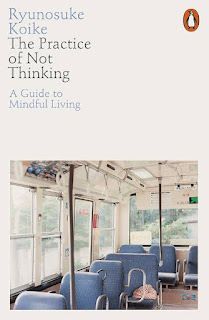
The Practice of Not Thinking - Ryunosuke Koike There is a distinction between thinking and awareness. Thinking is useful when needed, but becomes harmful when constant. On the other hand, awareness connects us with reality, especially through the body and senses. Thoughts are distractions from reality. Thoughts are often arising from the three poisons or fires, as Buddha says: RAGA clinging/grasping/greed); DYASHA (aversion, anger), and both of them arising from MOHA (ignorance/delusion) Greed: Greed is not only a craving for material things but also a mental attachment to outcomes, approval, success, or even happiness. Greed arises when we believe that something outside us will complete or fix us. The mind spins in desire, constantly seeking, which fuels overthinking. By not thinking, we stop feeding this constant seeking. Returning to the body and the present moment weakens the pull of desire. Anger: Anger is tied to the ego’s resistance to reality—wanting things to be other than t...

Few more books on mindfulness and Buddhism

Image
  The Quiet Mind: John E. Coleman Hypnotism and ESP (extrasensory perception) intrigued Coleman (Then an FBI agent), leading him towards meditation. U Ba Khin and his meditation center in Yangon, the capital of Burma: U Ba Khin was a senior Burmese government official and a meditation teacher. Although he was constantly busy, whenever he felt overwhelmed, he would pause, adopt the lotus position, and meditate for a few minutes to relieve his stress. For Coleman, this demonstrated that meditation could be integrated into daily life. This practice allows him to understand his own inner workings, leading to clear insight and freedom from suffering.  Coleman committed himself fully to the course. In fact, he was overly zealous about it, dedicating a significant amount of time to taking notes and analyzing every aspect of the practice. Clearly, he still wasn't any closer to quieting his mind. Krishnamurti: One day, Krishnamurti's brother, Nityananda, died. Despite his profound grie...

Satipaṭṭhāna Meditation Guide The Direct Path to Mindfulness and Liberation

Image
  Satipaṭṭhāna Meditation Guide  The Direct Path to Mindfulness and Liberation Introduction “This is the direct path for the purification of beings, for overcoming sorrow and lamentation, for the disappearance of pain and grief, for the attainment of the true path, and for the realization of Nibbāna.” Core Instruction: “Ekāyano ayaṁ maggo…” — This is the one and only way for the purification of beings. I. Contemplation of the Body ( Ānāpānasati / Kāyānupassanā ) Acknowledging the body as it is—impermanent, composite, and not-self. Philosophical Grounding The body is not a self but a composite of impersonal processes governed by impermanence ( anicca ), unsatisfactoriness ( dukkha ), and non-self ( anattā ). Mindfulness of the body cultivates grounded awareness and forms the base for deeper insight. Psychological angle: Anchoring attention to the body stabilizes the mind and develops interoceptive awareness. Meditation Instructions Mindfulness of Bre...